
FROM ALATAU CITY TO FORMULA 1: CREW CENTRAL ASIA 2026 FORUM CONCLUDES IN ALMATY
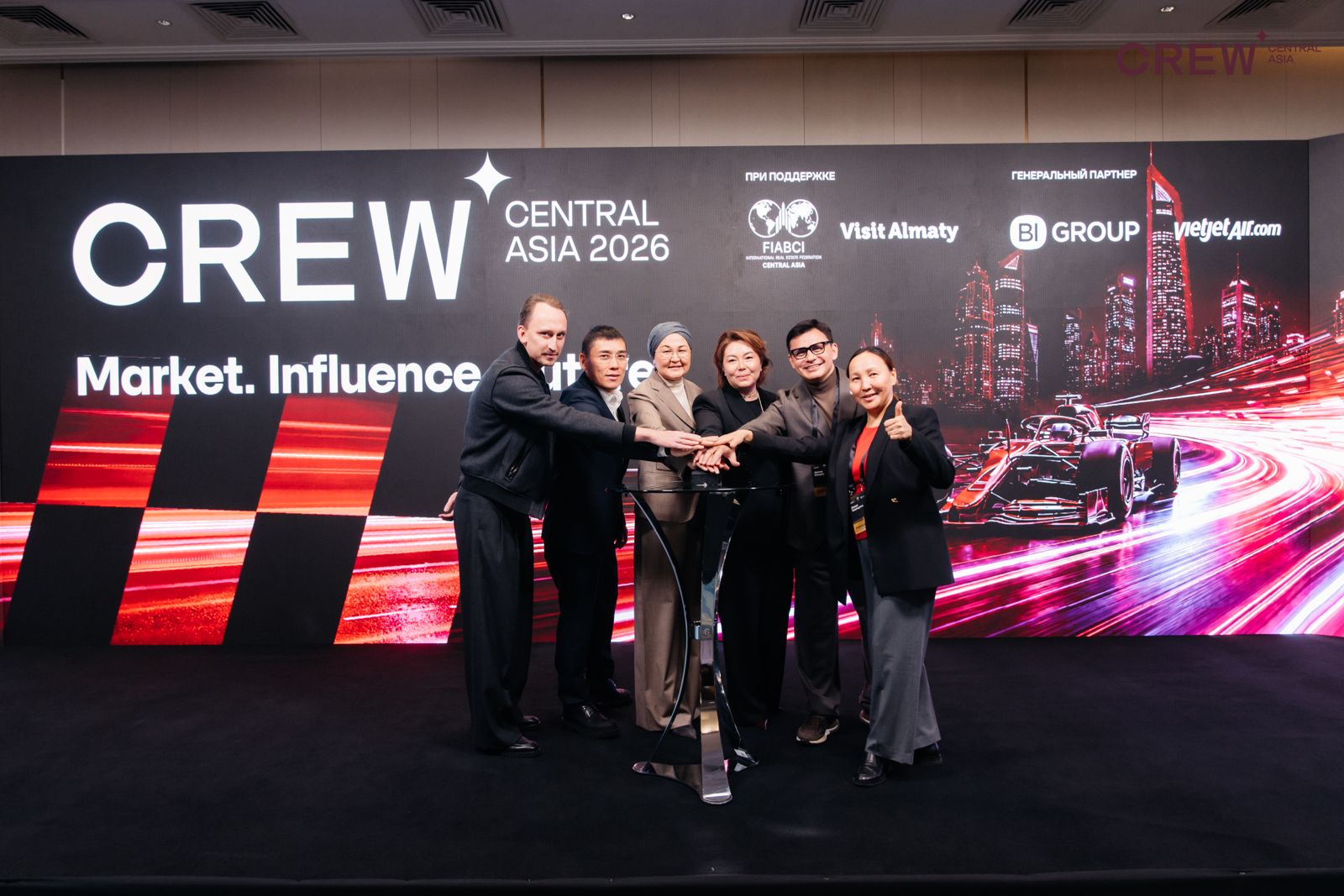
The CREW Central Asia 2026 forum — an international event on commercial real estate development and management — has concluded in Almaty, bringing together more than 200 participants from Kazakhstan, Central Asia, Europe, and the United States. Over two days, industry representatives discussed investment, the development of new cities, the transformation of commercial real estate, modern technology, and effective asset management.
The forum was held with the support of the International Real Estate Federation FIABCI Central Asia. The general partner was BI Group.
This year's theme — Market. Influence. Future. — reflected the changes shaping the industry today. New technologies, the emergence of economic centers, and the revision of investment strategies demand speed of decision-making, professional expertise, and a readiness to collaborate from businesses.
The importance of international dialogue was underscored in a video address to participants by FIABCI President Lily Chang. She highlighted the contribution of the federation's Central Asian chapter to knowledge exchange and the development of professional ties, calling on participants to more actively share ideas, find partners, and make use of the opportunities offered by the global community.
One example of how international experience and investment can influence the region's development was the discussion of Alatau City. The development of a new economic center between the cities of Almaty and Konaev was one of the central topics of the forum's first day. Participants examined the prospects for industry, logistics, and the digital economy, as well as the conditions needed to attract investors and implement development projects.
The development of these areas could generate new demand for commercial real estate — from warehouse and production complexes to office and retail properties. Here, the link between a city's development strategy and specific investment decisions is of key importance.
Aidan Ramazan, CEO of the Alatau SEZ management company, noted:
“The project envisions creating not only modern urban infrastructure, but also a new economic environment with industrial enterprises, logistics complexes, business centers, and commercial real estate facilities. To realize this potential, urban planning, the digital economy, and special conditions for business must work as a single system.”
The conversation about new points of growth continued in the session SPEED OF MARKET — “Industrial and Logistics Infrastructure of Central Asia”. Its agenda brought together issues of production, trade, and the movement of goods — areas for which modern warehouse infrastructure is becoming an important condition for growth.
Roman Fotiev, Executive Director of Griffin Logopark Almaty, noted the factors shaping demand for warehouse real estate:
“Historically, the main drivers of warehouse real estate growth have been rising trade turnover and the development of e-commerce. There are also fundamental factors: population growth, urbanization, the development of the consumer market, and the expanding range of retail chains. Together, these form sustained long-term demand for modern logistics space.”
On the second day, the focus of discussions shifted to how individual projects affect city life. The panel discussion of the SPEED OF CHANGE: City Development block was devoted to the shift from piecemeal construction to the systemic development of the urban environment: the commercialization of transport hubs, the development of tourist flow and hospitality real estate, and the infrastructure impact of MICE tourism and major events.
Such projects change not only a particular area but also familiar city routes, create jobs, and generate demand for new services. An airport becomes a point of attraction for business activity, a hotel supports the development of tourism, and a major event gives momentum to transport, retail, and service infrastructure.
In this context, the developer's role is becoming broader: it is important to understand how a facility will interact with the city, what benefit it will bring to residents and business, and how much in demand it will be in a few years. The link between an individual project and the development of the entire territory largely determines its long-term value.
The conversation about the quality of the urban environment continued with a presentation by American architect Hansel Bauman, co-founder of the DeafSpace Project at Gallaudet University (USA), who introduced the concept of inclusive architecture that takes into account the perception and communication needs of people with hearing impairments.
For commercial real estate, this approach has practical significance: attention to lighting, sightlines, the organization of walkways, and ease of communication helps create spaces that are comfortable for different users. Thus, the quality of a property is defined not only by its technical specifications but also by how well it meets human needs.
Alongside architectural and investment decisions, forum participants discussed management approaches for operating amid constant change. One of the most memorable moments was the presentation by Spanish racing engineer Xevi Pujolar, who has more than 20 years of experience in Formula 1.
He shared his experience of making decisions under high speed and responsibility, and spoke about the importance of preparation, teamwork, and effective management. His presentation connected the forum's theme with the practice of one of the world's most technological and competitive industries, where the outcome depends on precision of action and team coordination.
The overarching goal of these discussions — turning the exchange of experience into business opportunities — was defined by Aliya Serikpayeva, Head of CREW and President of FIABCI Central Asia:
“This year, CREW Central Asia is being held for the fourteenth time. The market is changing, new opportunities are emerging, but our goal remains the same — to bring international experience, knowledge, and investment to Kazakhstan and Central Asia, and to strengthen the professional expertise and competitiveness of market participants. We want as many promising projects from the region as possible to find investors and partners, and for meetings at the forum to turn into real deals and new business opportunities.”
The forum's festive conclusion was the CREW Awards 2026 ceremony, held on October 23 during a gala dinner. The award recognized the achievements of companies, projects, and professionals in real estate management, development, the office and retail segments, flexible spaces, and brokerage and consulting services.
Entries were reviewed by an international jury that included specialists from Kazakhstan, the United States, Indonesia, Hong Kong, Uzbekistan, and Kyrgyzstan, including FIABCI members and representatives of consulting companies. The experts assessed participants' results taking into account the specifics of each category.
CREW's work continues beyond the annual forum. Through the CREW Education educational programs, the CREW Club professional community, industry events, and the CREW Community Journal, the team supports the exchange of experience, strengthens international ties, and creates opportunities for new projects and business cooperation.
CREW CENTRAL ASIA: MORE THAN A FORUM
CREW (Commercial Real Estate World) is a professional platform for discussing current issues and strategic directions in the development of the commercial real estate market in Kazakhstan and Central Asia.
The first CREW Central Asia forums were held in Astana and Almaty in 2014. Over time, the annual forum was joined by educational programs, professional meetings, themed events, and an industry print publication.
Over 14 years, CREW events have brought together more than 4,500 delegates and 620 speakers, and around 120 business meetings have taken place.
CREW venues have hosted discussions on city development, the reconstruction and repurposing of real estate properties, investment, logistics, and the adoption of new technologies. Notable international guests have included Donald Trump Jr., American entrepreneur and Executive Vice President of The Trump Organization, involved in real estate development and management, and Chris Gardner, American entrepreneur, investor, and author of the autobiography “The Pursuit of Happyness,” which inspired the film of the same name starring Will Smith. Their presentations, like meetings with other international experts, gave participants the chance to learn from practical experience in business, leadership, and project management.
Today, CREW brings together several interconnected areas, ranging from professional education and business events to the development of the industry community and international cooperation.
FOUNDER OF CREW
Aliya Serikpayeva is the founder of CREW Central Asia and President of the Central Asian chapter of the International Real Estate Federation, FIABCI.
From its earliest days, CREW has worked to develop the professional commercial real estate community, creating opportunities for industry dialogue, the exchange of international experience, the promotion of promising regional projects, and the establishment of business partnerships.
INTERNATIONAL COOPERATION
FIABCI-CENTRAL ASIA
FIABCI (International Real Estate Federation) is an international real estate federation founded in Paris in 1951. The federation is represented in 83 countries and brings together specialists from more than 40 real estate–related professions.
FIABCI Central Asia promotes the development of international professional ties, the exchange of experience, and the promotion of regional projects on global platforms. Its activities include participation in the international real estate exhibition MIPIM and the FIABCI World Prix d’Excellence award, which recognizes outstanding real estate projects.
IREM
IREM (Institute of Real Estate Management) is CREW's international professional partner in training real estate management specialists.
The partnership, launched in 2014, gives specialists in the region access to the international certification program CPM® (Certified Property Manager) and to modern real estate management practices.
The training covers property and asset management, financial performance, real estate operations, and interaction with owners and tenants.
CREW CLUB
CREW Club is a professional community of developers, property owners, investors, management companies, architects, consultants, brokers, and representatives of related industries.
Club residents meet regularly, share experience, discuss current market issues, and analyze practical cases. The program includes business breakfasts, seminars, webinars, professional discussions, and Property Tours — organized visits to commercial real estate properties.
These formats allow participants to learn about new projects, find partners, exchange professional expertise, and jointly seek solutions to industry challenges.
CREW AWARDS
CREW Awards is a professional award in development and commercial real estate, judged by an international panel of experts. The award recognizes the achievements of companies and professionals, the quality of completed projects and decisions, and participants' contributions to the industry's development.
The categories cover real estate management, development, office and retail properties, flexible spaces, brokerage and consulting services, significant deals, and individual professional achievements.
CREW COMMUNITY JOURNAL
CREW Community Journal – an information and analytical magazine on commercial real estate in Kazakhstan and Central Asia. The publication introduces readers to industry projects and companies and covers investment, architecture, technology, and commercial real estate management.